
Why Taking Just One Supplement Usually Isn’t Enough
Category: Nutrition & Wellness | Reading time: 4 min
“I already take vitamin D.”
It’s one of the most common things people say when the conversation turns to supplementation. And it’s usually said with a sense of relief — the nutritional bases are covered, the problem is handled, move on.
Here’s the part that doesn’t usually come up in that conversation: taking a single supplement in isolation is often far less effective than the research on that supplement suggests it should be. And in some cases, it may be doing considerably less than you think.
This isn’t a reason to stop taking vitamin D, or omega-3, or magnesium. It’s a reason to understand how these nutrients actually function — and why the most important supplement decision isn’t which one to take, but whether you’re addressing the system rather than a single variable.
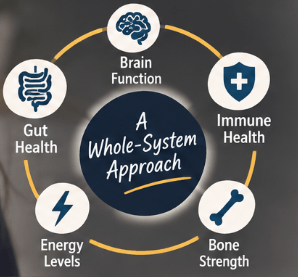
Nutrients work in networks, not in isolation
The human body doesn’t run on individual nutrients the way a car runs on a single type of fuel. It runs on interacting networks of vitamins, minerals, and cofactors, each of which depends on others to function properly.
Research has documented this principle in a way that directly challenges the single-supplement approach. One published analysis of the relationship between omega-3 fatty acids, vitamin D, and B vitamins — specifically the homocysteine marker that reflects B vitamin status — found that deficiency in all three simultaneously produced a dementia risk that was larger than the risk associated with diabetes or high cholesterol. Critically, the risk profile wasn’t just additive — it was compounding. Having all three gaps open at once was far more dangerous than having one.
The same logic appears across the broader nutrient research: single-nutrient supplementation trials have consistently produced weaker and less consistent results than combined-nutrient approaches. Researchers studying brain aging found that single nutrients often failed because, in the authors’ words, “nutrients are part of interacting processes with other nutrients quickly becoming limiting.” Fix one gap and something else becomes the bottleneck.
What addressing the system actually looks like
The alternative isn’t complicated. It’s addressing the foundational gaps comprehensively rather than sequentially.
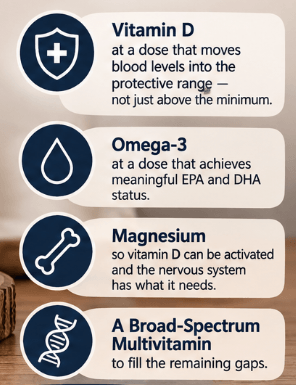
That means vitamin D at a dose that actually moves blood levels into the protective range — not just above the minimum. It means omega-3 at a dose that achieves meaningful EPA and DHA status. It means magnesium, so that vitamin D can be activated and the nervous system has what it needs to regulate properly. And it means a broad-spectrum multivitamin to fill the remaining gaps the triage theory tells us are quietly being paid for in long-term health.
The research on combined nutrient sufficiency is consistent: the body works as an integrated system, and supporting that system comprehensively produces outcomes that piecemeal supplementation simply doesn’t.
This is why the Livin’ Well Wellness Pack is structured the way it is. Not four supplements chosen arbitrarily, but four nutrients with documented interdependencies, at doses grounded in the evidence, designed to address the most common and consequential nutritional gaps in a single daily routine.
If you’re already taking one of these nutrients, you’re on the right track. The question worth asking is whether the other three are where they need to be — and whether the dose you’re taking is actually getting you to sufficiency. The Wellness Pack is how we ensure all the gaps are being addressed and that patients are getting the essential nutrients their body needs to get and stay well.
The specific interdependencies that matter
Some of these relationships are direct and well-documented:
Vitamin D needs magnesium to work. Your body converts vitamin D into its active steroid hormone form through an enzymatic process that requires magnesium as a cofactor. If you’re taking vitamin D but running low on magnesium, you may be supplementing a precursor that your body can’t fully convert. The vitamin D is there — the machinery to activate it isn’t.
Vitamin D and omega-3 amplify each other. Both nutrients support immune regulation and the resolution of inflammation — but through partially overlapping and complementary pathways. Research on co-supplementation consistently shows that taking both together produces greater improvements in immune markers, inflammatory balance, blood sugar, cholesterol, depression, and anxiety than either nutrient produces alone. They don’t just add up — they interact.
Omega-3 and vitamin D together cut autoimmune disease risk by 30 percent. A landmark five-year randomized controlled trial found that combined supplementation with both nutrients reduced the incidence of new autoimmune diagnoses by approximately 30 percent compared to placebo — with the protective effect growing stronger over time. This is one of the most compelling findings in recent nutritional research. Neither nutrient alone produced that result.
B vitamins close the dementia-risk loop. The same research that documented the combined impact of low vitamin D, low omega-3, and low B vitamins on dementia risk found that addressing all three together was where meaningful protection appeared. Each nutrient addressed one part of the pathway — none of them were sufficient addressing it alone.
The dosing problem compounds the isolation problem
There’s an additional layer to this: most people who take a single supplement take it at a dose that falls short of what the research actually supports.
The most common example is vitamin D. Many people who “already take vitamin D” are taking somewhere between 400 and 1,000 IU per day — a range that sounds meaningful but is considerably below the 4,000 to 5,000 IU per day shown in research to support optimal blood levels. Standard prenatal vitamins typically contain 400 IU. Standard multivitamins commonly contain 600 to 800 IU. These doses, by the evidence, move the needle modestly at best.
The same pattern appears with omega-3. A standard fish oil capsule often contains 300 to 500 mg of actual EPA and DHA — while research on meaningful cardiovascular protection suggests the target is closer to 1,600 mg per day or more. Many people taking fish oil daily are achieving a fraction of what the evidence-based target requires.
Single supplements at subtherapeutic doses, taken without the supporting nutrients their function depends on, is probably the most common way supplementation fails in practice.
These statements have not been evaluated by the Food and Drug Administration. This content is for educational purposes and is not a substitute for individualized medical advice.