
Omega-3 Fatty Acids: Why the Modern Diet Gets This One Dangerously Wrong
Category: Nutrition & Wellness | Reading time: 5 min
There’s a category of fat the human body cannot make on its own. It has to come entirely from what you eat. Your heart depends on it. Your brain is built from it. Your joints need it to manage the daily wear of being alive. And the average American gets about a tenth of the amount the research suggests is protective.
Omega-3 fatty acids — specifically EPA and eicosapentaenoic acid and DHA, or docosahexaenoic acid — are essential fats. “Essential” in nutrition has a specific meaning: the body requires it, cannot synthesize it, and must obtain it from external sources. When those sources aren’t adequate, things go wrong. Not immediately, and not obviously. But over time, in ways that compound.
This is the story of a nutrient the modern diet systematically fails to provide, and why that matters more than most people realize.

How we got here
For most of human history, omega-3s were abundant in the food supply. Wild game, fatty fish, and foraged plants all provided meaningful amounts of EPA and DHA. The ratio of omega-3 to omega-6 fatty acids in the ancestral human diet is estimated to have been close to 1:1.
The modern Western diet has flipped that ratio dramatically. Processed seed oils, grain-fed rather than grass-fed meat, and a diet centered on shelf-stable packaged foods have pushed omega-6 intake far higher while omega-3 (EPA and DHA) intake has stayed flat or declined. Current estimates put the modern American omega-6 to omega-3 ratio somewhere between 15:1 and 20:1. Some estimates go higher.
This imbalance matters because omega-6 and omega-3 fats compete for the same metabolic pathways. When omega-6 dominates, it tilts the body’s baseline inflammatory state. When omega-3 is sufficient, it supports the resolution of inflammation — the process of calming it down after a threat has passed. The modern diet, in effect, keeps one foot on the accelerator and removes the brake.
What the research shows
The body of evidence on omega-3 fatty acids is one of the most extensive in nutritional science. A few landmark findings:
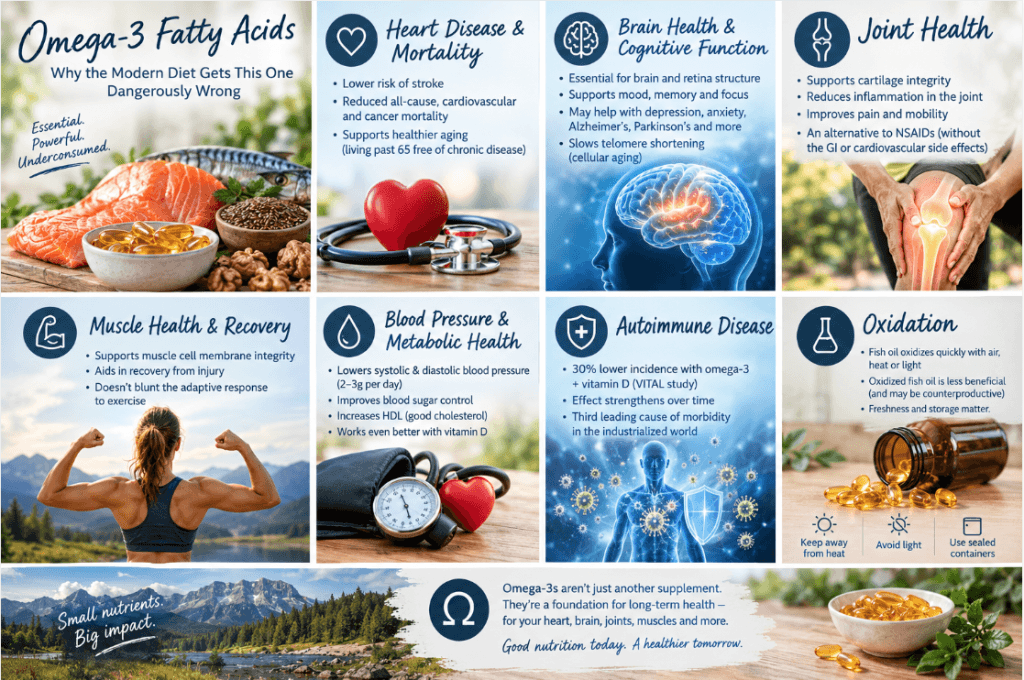
Heart disease and mortality. A pooled analysis of data from nearly 183,000 participants across 29 prospective studies found that higher blood levels of EPA and DHA were associated with significantly lower risk of stroke. A separate analysis from Mayo Clinic Proceedings found that higher DHA levels were linked to meaningful reductions in all-cause mortality, cardiovascular mortality, and cancer mortality. Research from the Cardiovascular Health Study associated optimal omega-3 levels with “healthier aging” — defined as surviving past 65 free of chronic disease and with good functional status.
Brain health and cognitive function. DHA is a primary structural component of brain tissue and the retina. Omega-3 supplementation has been studied in contexts ranging from depression and anxiety to schizophrenia, Alzheimer’s disease, and Parkinson’s. Low blood levels of DHA and EPA have been associated with faster telomere shortening — a cellular marker of aging — and supplementation has been shown to slow that shortening.
Joint health. Research on osteoarthritis — one of the most common conditions seen in a chiropractic setting — shows that omega-3 supplementation supports cartilage integrity, reduces pro-inflammatory signaling in the joint, and improves pain and mobility. This is an alternative to NSAIDs that addresses the underlying inflammatory mechanism rather than masking symptoms, without the gastrointestinal and cardiovascular side effects associated with long-term NSAID use.
Muscle health and recovery. Fish oil has been identified as one of only a small number of supplements with evidence for improving musculoskeletal health in aging. It supports muscle cell membrane integrity, aids in recovery from injury, and — importantly — does not blunt the adaptive response to exercise, making it appropriate for both active and sedentary individuals.
Blood pressure and metabolic health. A dose-response meta-analysis in the Journal of the American Heart Association found that 2 to 3 grams per day of omega-3 produced the most meaningful reduction in both systolic and diastolic blood pressure. Blood sugar control and cholesterol profiles — specifically HDL levels — also improve with consistent omega-3 supplementation, particularly in people who are also deficient in vitamin D.
Autoimmune disease. A large, five-year randomized controlled trial (the VITAL study) found that omega-3 supplementation, combined with vitamin D, reduced the incidence of autoimmune disease by approximately 30 percent compared to placebo — with the effect strengthening over time. Autoimmune disease is the third leading cause of morbidity in the industrialized world. A 30 percent reduction is not a small number.
Oxidation. Fish oil oxidizes quickly when exposed to air, heat, or light. Oxidized fish oil is not only less beneficial — it may actually be counterproductive. Freshness and storage matter.
The synergy with vitamin D
It’s worth noting that omega-3 and vitamin D don’t just happen to be included in the Wellness Pack together — their effects are genuinely synergistic. Multiple studies have now documented that co-supplementation with both nutrients produces better outcomes across a range of health markers than either nutrient alone. They share overlapping pathways in immune regulation and inflammation resolution, and vitamin D’s effectiveness in some contexts appears to depend on adequate omega-3 status.
This is one of the clearest arguments for addressing nutrient sufficiency comprehensively rather than one supplement at a time. Livin’ Wells Wellness Packs are an easy way to take the confusion and guess work out of your supplement routine. It has all the high quality essential nutrients your body needs in a single daily pack. If you would like more information on our Wellness Packs please ask one of your team members on your next visit.

These statements have not been evaluated by the Food and Drug Administration. This content is for educational purposes and is not a substitute for individualized medical advice.