
You eat well. You cook at home most nights, you try to get vegetables on the plate, and you take your health seriously enough to read articles like this one. So why might you still be running low on the nutrients your body needs most?
The answer has less to do with your habits than with the world those habits exist in. Over the last century, the nutrient content of our food supply has declined dramatically, our working lives have moved indoors, and our diets have drifted toward convenience. The result is a population that is simultaneously overfed and undernourished — not starving by any historical measure, but running on a low tank of the specific micronutrients that drive long-term health.
This isn’t a fringe claim. It’s documented in peer-reviewed research from institutions like the Proceedings of the National Academy of Sciences, and it shows up in the data on chronic disease rates every year.
The soil problem no one talks about
Start with where food comes from. A hundred years ago, the soil that grew American produce was rich in minerals — magnesium, zinc, iron, and dozens of other trace elements that plants absorb and pass on to us. Modern industrial farming, with its reliance on phosphate-based fertilizers and intensive harvesting cycles, has stripped much of that mineral content from the soil. Estimates suggest that vegetables grown today contain 80 to 90 percent less magnesium than the same vegetables grown a century ago.
Read that again. The spinach on your plate is not the spinach your great-grandmother ate. It looks the same. It tastes similar. But the mineral content has declined so sharply that eating a balanced diet no longer guarantees a sufficient intake of several critical nutrients.
And then cooking further reduces what little is left. Processing techniques like grain bleaching and vegetable boiling can eliminate up to 80 percent of remaining mineral content. Fluoride in tap water — present in the drinking water of about three-quarters of the American population — blocks absorption of certain minerals. Alcohol and caffeine increase the rate at which others are excreted. The modern food supply, even at its best, starts at a deficit.

The indoor life and the vitamin D collapse
Add to the soil story a more recent shift: we stopped going outside. Vitamin D is the one nutrient the body can manufacture on its own, but only through direct sun exposure on bare skin. That’s how humans lived for most of history — outdoors, in the light, at latitudes where sun exposure was adequate year-round.
Today, the average American spends around 90 percent of their time indoors. In northern states like Wyoming, where meaningful sun exposure is limited to a handful of months and covered by clothing for much of that time, the body’s ability to self-supply vitamin D is severely constrained. Estimates suggest that somewhere between 60 and 100 percent of people who don’t supplement are running low on vitamin D — making it the single most common nutrient deficiency in the world.

Your body makes trade-offs you don’t know about
Here’s where this gets important in a way that goes beyond just “eat your vegetables.”
Research published in the Proceedings of the National Academy of Sciences introduced a concept called the triage theory, and it reframes what nutrient deficiency actually means for your long-term health. The idea is this: when your body is short on a critical nutrient, it doesn’t just run low evenly across all systems. It makes a strategic decision. It routes the scarce nutrient toward the proteins and processes needed for immediate survival — keeping your heart beating, your immune system active, your basic functions running — while quietly rationing away from the proteins responsible for long-term protection.
The damage this causes is insidious. It doesn’t show up as a symptom you’d notice today. It accumulates slowly, over years and decades, and eventually surfaces as the chronic diseases we tend to attribute to “aging” — heart disease, cancer, cognitive decline, osteoporosis, autoimmune disorders.
In other words: you can feel completely fine right now and still be setting yourself up for serious health problems twenty years from now, simply because your body has been short on a handful of nutrients and quietly prioritizing your survival over your longevity.
This is why the conversation about supplementation is worth taking seriously — not as a substitute for a good diet, but as a recognition that the modern food supply, modern lifestyle, and modern indoor environment have created a genuine gap between what our bodies need and what they’re getting.

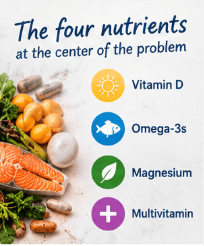
The four nutrients at the center of the problem
Research consistently points to four specific nutrients where deficiency is most widespread, most consequential, and most correctable through supplementation.
Vitamin D is involved in the function of virtually every cell in the body. Beyond its well-known role in bone health, it supports immune regulation, muscle function, mood stability, and the activity of thousands of genes. Deficiency has been associated with a remarkably broad range of health problems. Most people who don’t supplement are low on it.
Omega-3 fatty acids are essential fats the body cannot produce on its own, meaning they must come entirely from diet. They support heart and brain health, joint comfort, and the body’s ability to manage inflammation appropriately. The average American gets a fraction of what the research suggests is optimal.
Magnesium is involved in more than 300 enzymatic processes — energy production, muscle contraction and relaxation, nerve signaling, blood sugar regulation, heart rhythm, DNA repair, and more. It’s the mineral that runs more of your body’s background processes than almost any other nutrient, and nearly half of Americans don’t consume enough of it.
A high-quality multivitamin fills the remaining gaps — the vitamins and minerals that a depleted food supply consistently under-delivers, and that the triage theory tells us are quietly being rationed away from your long-term health every day you’re short on them.
Why “I eat pretty well” isn’t enough
This is the part that surprises people the most. Even genuinely health-conscious eaters — people who prioritize vegetables, minimize processed food, and pay attention to what they put in their bodies — consistently fall short on these four nutrients. It’s not a discipline problem. It’s a structural one.
To get adequate omega-3 from food alone, you’d need roughly six ounces of salmon every day. To get enough vitamin D from diet alone is essentially impossible without supplementation in most northern climates. Magnesium is present in leafy greens and whole grains, but the amounts have declined so substantially that even eating those foods daily doesn’t guarantee sufficiency.
The goal isn’t to make you feel like your diet has failed you. It’s to be honest about the environment we’re all living in and the gap that exists between what our genes expect and what the modern world provides.

What we do about it at Livin’ Well
The Livin’ Well Wellness Pack was built around these four nutrients specifically because the research behind each one is deep, the deficiency rates are high, and the interactions between them matter. Vitamin D and magnesium, for instance, depend on each other — your body needs magnesium to convert vitamin D into its active, usable form. Vitamin D and omega-3 work synergistically to support the body’s inflammatory response. The multi covers the remaining foundational gaps.
It’s a 30-day supply of four practitioner-selected supplements, designed to address the most widespread nutritional shortfalls in a single daily routine. This is an essential nutrient system that our doctors recommend for every patient, everyday, for life because it’s that important to your health and longevity. Next time you’re in the office ask one of our team members about starting your Wellness Pack.

Want to go deeper on any one of these? We’ve written individual posts on each nutrient in this series
Blog #2 (Wellness Pack Series) Vitamin D.docx
Blog #3 (Wellness Pack Series) Omega3_.docx
Blog #4 (Wellness Pack Series) Magnesium.docx
Blog #5 (Wellness Pack Series) Multivitamin.docx
Blog #6 (Wellness Pack Series) Bringing it all together.docx
These statements have not been evaluated by the Food and Drug Administration. This content is for educational purposes and is not a substitute for individualized medical advice.