Vitamin D Deficiency: The Most Common Nutrient Problem You’ve Never Been Told You Have
If you live in Wyoming and you don’t take a vitamin D supplement, there’s a good chance you’re running low on it right now — regardless of how well you eat, how much time you spend outdoors in summer, or how healthy you generally feel.
That’s not an exaggeration. Research suggests that somewhere between 60 and 100 percent of people who don’t supplement are below optimal vitamin D levels, with the upper end of that range applying especially to people living at northern latitudes with cold winters and limited sun exposure. Wyoming qualifies on both counts.
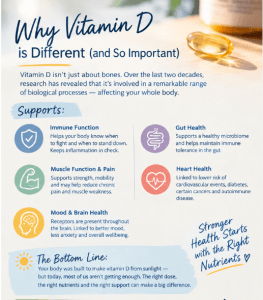
The reason this matters goes far beyond bone health — the role vitamin D is famous for. Over the last two decades, research has revealed that vitamin D is involved in a remarkable range of biological processes, and that running low on it quietly affects far more than your skeleton.
Why vitamin D is different from other nutrients
Most vitamins and minerals come from food. Vitamin D is unique: the body can manufacture it, but only through one specific mechanism — ultraviolet B light hitting bare skin and triggering a conversion process that eventually produces the active form of the nutrient.
For most of human history, that mechanism worked well. People lived and worked outdoors, in climates and at latitudes where sun exposure was reliable. The system was designed for a life largely lived outside.
That’s not the life most of us live today. The average American spends roughly 90 percent of their time indoors. When we do go outside in cold months, we’re clothed from neck to ankle. Also, sunscreen blocks the UV exposure that drives vitamin D production. At Wyoming’s latitude, meaningful UVB exposure for vitamin D synthesis is essentially absent from October through April even on clear days due to the angle at which the sun hits the atmosphere.
The result is a population almost universally short on a nutrient the body was built to produce in abundance.
What vitamin D actually does
For decades, vitamin D’s role was understood primarily in terms of calcium absorption and bone density. That remains true — but it turns out to be a small part of the picture.
Researchers have identified approximately 2,700 locations in the human genome where the vitamin D receptor protein binds and influences gene expression. In practical terms, this means vitamin D is involved in regulating thousands of biological processes. Among the most well-documented:
Immune function. Vitamin D is essential for healthy immune regulation — not just for mounting a defense against pathogens, but for knowing when to stand down. Without sufficient vitamin D, the immune system can become dysregulated, driving inflammation beyond what’s useful. This relationship appears in research on autoimmune conditions, respiratory illness, and general immune resilience.
Muscle function and pain. Research consistently links low vitamin D levels to musculoskeletal pain, including chronic low back pain, myalgia, and generalized muscle weakness. Studies suggest that optimizing vitamin D levels — particularly getting above 40 ng/mL rather than the more commonly cited threshold of 20 ng/mL — supports meaningful pain reduction in people who are deficient.
Mood and neurological health. Vitamin D receptors are present throughout the brain. Deficiency has been associated with depression and anxiety, and supplementation has shown measurable improvements in psychological wellbeing in research settings, particularly when combined with omega-3 fatty acids.
Gut health. More recent research has shown that vitamin D plays an important role in supporting a healthy gut microbiome, promoting diversity and balance among beneficial bacteria, and supporting the immune tolerance that keeps gut inflammation in check.
Cardiovascular health. A consensus statement from 27 vitamin D researchers acknowledged associations between deficiency and increased risk of cardiovascular events, diabetes, certain cancers, and autoimmune disease.
The dosing problem
Here’s where a lot of confusion lives. The government’s longstanding recommendation for vitamin D has been in the range of 600 to 800 IU per day — a number established decades ago based primarily on bone health outcomes and an outdated understanding of what vitamin D does.
More recent research tells a different story. Studies suggest that achieving optimal serum vitamin D levels — generally considered to be between 40 and 70 ng/mL for broad health protection — requires somewhere in the range of 4,000 to 6,000 IU per day for most adults. That’s six to ten times the official recommendation.
This gap between the official guidance and what the evidence supports is why so many people supplement with vitamin D and still come up short. A standard prenatal multivitamin, for instance, typically contains 400 IU — the equivalent of about a tenth of what research suggests is needed. Studies on childhood asthma prevention found meaningful protection at 4,400 IU per day of supplemental D in pregnant mothers, compared to virtually none at the standard 400 IU dose.
The fear of vitamin D toxicity — which has historically kept recommendations low — has been substantially revised by newer data. Studies suggest no increased risk of adverse effects even at blood levels considerably higher than what 4,000 to 6,000 IU per day would typically produce.
Why your blood test might not tell you the whole story
There’s an additional wrinkle worth understanding. Standard vitamin D blood tests measure serum levels — the amount circulating in your blood. These tests are useful, but they come with a significant caveat: vitamin D in the blood represents only a portion of what’s happening in your tissues. The question isn’t just whether you have measurable vitamin D circulating — it’s whether you have enough to meet the demands of all the systems that depend on it.
The government’s “normal” threshold of 20 ng/mL, for instance, was established primarily to prevent rickets (a bone deformity). Research on broader health outcomes suggests a target closer to 40 ng/mL or above is where meaningful protection against chronic disease risk appears. A test result that comes back “normal” by the 20 ng/mL standard may still represent a functionally low level for immune health, pain management, and long-term protection.
Getting it right
Vitamin D supplementation is one of the most straightforward, well-supported, and cost-effective things you can do for your health — but it only works at the right dose. A supplement that provides 400 IU isn’t meaningfully moving the needle. The sweet spot in the research is in the range of 4,000 to 5,000 IU per day as a maintenance dose for most adults.
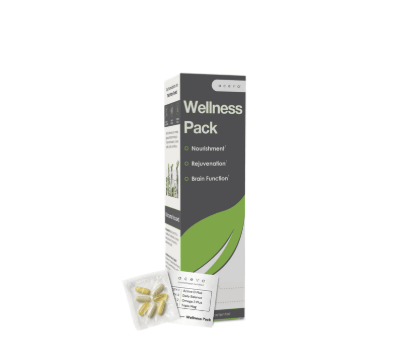
It also works better in combination with other nutrients. Vitamin D requires magnesium for its conversion into the active form your cells can use. And its effects on immune regulation and inflammation are amplified when omega-3 fatty acids are also sufficient. That’s why we don’t just recommend vitamin D in isolation — the rest of the Livin’ Well Wellness Pack exists for exactly this reason.
Our Wellness Packs contain a high quality Vitamin D at the right dose for true sufficiency, which is 5,000 IUs. It also comes with all of the other nutrients that are needed for the body to maximize Vitamin D’s benefits, such as Magnesium and Omega 3 Fatty Acids. All of your essential nutrients in a 30 day supply, packaged for daily use, and at an unbeatable price for the quality. Next time you’re in the clinic ask about starting your Wellness Pack!
These statements have not been evaluated by the Food and Drug Administration. This content is for educational purposes and is not a substitute for individualized medical advice.